Last updated: May 2026
A creative block is a temporary stall in a creative person's ability to generate ideas or push a project forward, most commonly triggered by exhaustion, perfectionism, lack of input, or external pressure. There's no single fix that works for everyone, but the creatives we sat down with consistently rely on a small set of moves: switching the medium they're working in, stepping away from the screen, mining different industries for inspiration, and sleeping on the problem. The interview below pulls those moves into one place, with two Major Tom creatives walking through what actually works for them.
Quick takeaways — how to overcome a creative block:
It's this question, or some variant of it, young creatives always ask us. Creative blocks, staying motivated, overcoming imposter syndrome, or even just getting started are barriers every creative person experiences. But the feeling that comes with hitting a stride and creating something from nothing keeps us pushing through those barriers. Creativity is the engine of business innovation, and learning how to work through the blocks is part of the job.
World Creativity and Innovation Day is celebrated internationally each year on April 21st. The day was established by the United Nations to honor the creative and innovative activities of people around the world.
As members of a creative industry, we're all about celebrating creativity and innovation. We wanted to take Creativity and Innovation Day one step further and give back to our community with some tangible advice, thoughts, and general knowledge about how to overcome common challenges in our field.
We sat down with a few members of the creative team at Major Tom — Geoff Ravenor, Darren Maher, Ed Egydio, and Carolina Horna — to see what they had to say.
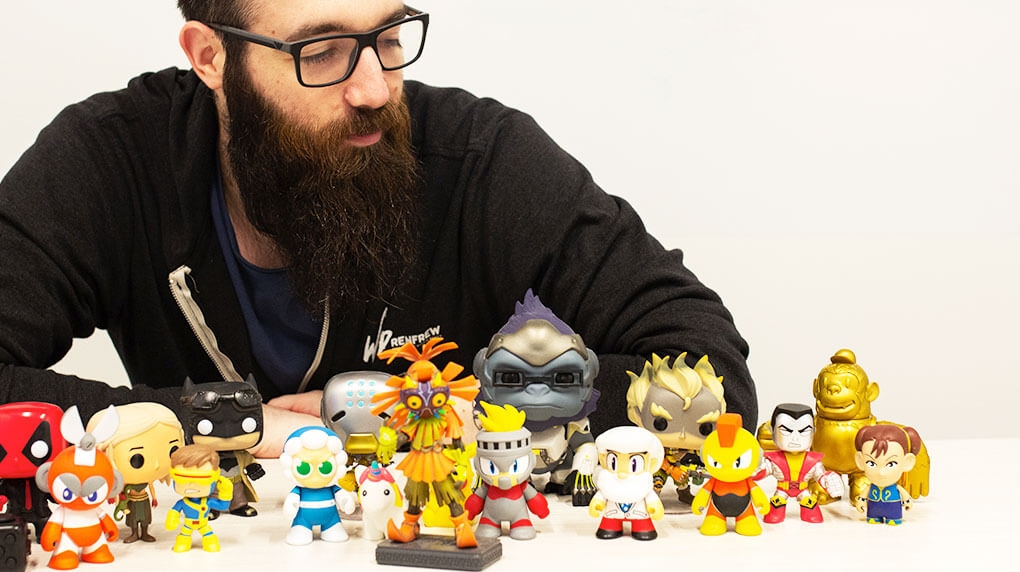
Geoff Ravenor, a business school drop out who fell in love with photography, is a visual designer at Major Tom. He tells us he finds inspiration walking around outside and, alternatively, diving into the digital world. Geoff's go-to design blogs include Abduzeedo and Brand New when he wants to "see what else is out in the world". His creative outlets outside of work include painting miniature models, which he uses as an exercise to "play with colors" and clear his mind.

Geoff: "Even though my job is very visual, I usually start most projects by looking at words. Whether I'm working on a rebrand or website the thesaurus is my go-to tool. I use it to build a list of words that best describe what it is I'm trying to create. It helps me understand what colors, typefaces, photography or illustration style would be appropriate to ensure the project presents itself with the right personality to the world."
Being able to articulate your design helps clarify the creative direction you need to take. Geoff's process — using a thesaurus and building a list of words to describe what he's creating — gives you a way to describe and direct what you intuitively know.
Geoff: "I'm either really bad at recognizing I've hit a creative block or I'm in denial and just try to push through it. But when I do finally come to my senses I'll either switch the project I'm working on to shake things up, or I'll just pack it away and take the night to sleep on it and usually an idea springs up when I'm not even thinking about it."
Recognizing you've hit a creative block isn't always obvious. Aimlessly searching the internet, getting increasingly frustrated with a project, or not knowing what to do next can all be signs that it's time to take a step back and reassess.
Geoff: "With working from home I've found productivity to be extremely high but creativity very low. When you're not surrounded by immensely talented and creative people every day it's hard to feel inspired. Additionally, not having their creative minds within earshot at a moment's notice to bounce ideas off of makes things more difficult as well. So my solution has really been to get outside and walk walk walk (obeying the 2m distancing rule of course). I have to get my eyes off of a screen and get outside to enrich all my senses to get the creative juices flowing again."

Geoff's experience of high productivity and low creativity when working from home is a universal one. The New York Times has an entire article on exactly this: Kevin Roose writes that although research shows workers gaining productive hours while working from home, they're missing those harder-to-measure benefits like creativity and innovative thinking. Team cohesion and problem-solving suffer with remote collaboration.
Luckily, we live in a time when technology has connected us more than ever before. Don't be afraid to hop on a ten-minute call to chat through an issue you're having with your team.
Geoff: "There is always a point in my projects where I reach rock bottom. The point where what I make sucks, my ideas suck, I suck, my career is in ruins and I'm a fraud. All of this happens because I place such lofty goals and expectations on my work, which usually end up being much higher than those of the client.
So my advice for anyone else is before you start a project, run your goals for the project past someone else and see if they feel if what you're planning is achievable with the perimeters of the project. Because perhaps what you have planned will push the limits of the budget or timeline or technological ability. It's good to get an outside perspective to look at what you're planning and make sure it's doable within these boundaries."
Placing too high of expectations on yourself, or not setting realistic project goals, is a fast lane to burnout. It's easy to get ahead of yourself when you can see how great a project has the potential to be. The trick is keeping your own limits in view: stop overextending yourself, stop holding yourself up to an unsustainable standard. As Geoff says, your coworkers can be trusted unbiased sources for a reality check on your work or your project goals.
Geoff: "At the end of the day it's just a job. And even if you have mixed feelings about the end result as long as the client is happy with the result, that's a win. There will always be something you wish you could change about the work you've done. But that's what you learn and apply to the next project. There is no use looking back."
This is for the perfectionists everywhere: at some point, you have to stop. Edits and reworks should only take you so long. In a subjective, creative field, knowing when to let go of a project matters as much as knowing how to start one. If your client is happy, you've done your job.
Deciding on a career, especially when you're young, is a daunting task — not everyone knows "what they want to be when they grow up". Darren Maher, with no idea what he wanted to do with his life, took an aptitude test that pointed him in the direction of a creative career. That test was a catalyst to Darren studying Multimedia Applications Development for four years before starting a freelance career. After moving to Canada, he cut his teeth at a small startup.

We asked Darren where he finds inspiration. "In everything, really," he answered. "I always try to be alert to what's around me and what grabs and holds my attention. Then question why that is. Once I have an understanding of that, I can apply it to my work." Asking yourself why something is inspiring or attention-grabbing helps you understand the basic mechanics of good design, persuasive advertising, or even human nature. Why do we love videos like Google's Year in Search? Because they evoke an emotional response, and emotions can be incredibly persuasive.
Darren also finds inspiration in Awwwards, Brand New (much like Geoff), The Futur (specifically, Chris Do's pieces), and the journeys, successes, and failures specific to his childhood football heroes.
Darren: "I like to assess my mood and then find a good playlist on Spotify that relates to my mood. Music is really important for me to get in the zone."
Research shows that music can lower anxiety and increase divergent thinking.
Darren: "I move away from that project. For myself, I can't force through creative blocks. Start working on something else, go for a walk, play a video game. Basically, I'm just trying to stop thinking about it on a conscious level. Subconsciously the problem is still there and you are working through it with all the parameters like audience demo, goals, differentiators, etc., and if your mind is more relaxed ideas come easier."
Darren's process is grounded heavily in science. When your mind is relaxed and engaged in an activity that doesn't take much attention, your brain works through problems on a subconscious level. That distraction-method draws on the problem-solving resources of your non-conscious mind, which, according to Psychology Today, are "millions if not billions of times larger than that of the conscious."
The subconscious is where Aha! moments live, alongside Rorschach interpretations and the reason that one song stays stuck in your head all day. Mundane tasks are how you let it work.
Darren: "If you are experiencing imposter syndrome, welcome to the club. Every creative goes through it. To get through it, look over past work you've done that you are happy with. It's nice to remind ourselves that we are capable of good work when we are doubting ourselves.
There are 5 different types of imposter syndrome: get familiar with them and identify which types you fall into. Understanding why you feel that way and owning it can be quite liberating."
Dr. Valerie Young, the expert on imposter syndrome, has identified five different types. As Darren says, understanding which applies to you gives you the tools and language to make sense of the feeling, which is the first step toward moving past it. Our companion piece, Part 2 of this series, digs deeper into imposter syndrome and how to work through it.
Darren: "For me personally I love looking outside of my industry and learning about different approaches to creativity through different mediums. Like how Disney's Imagineers work, how the X-men animated series was created, the hurdles encountered building the game Ori and the Blind Forest, and how they did the special effects on Shaun of the Dead.
What you should take away is that there is no true approach to creativity that everyone can follow. If you find something works for you, embrace it. So many incredible innovations happen because of limited resources."
That cross-industry curiosity is one of the most reliable creative-block remedies any of our team relies on. If you're working through a brand or campaign that needs that kind of fresh thinking, the Major Tom team can help — see how we approach brand strategy, or browse our case studies for examples of creative work in market.
This is part 1 of a 2-part series on overcoming creative blocks. Read part 2 now.
A creative block is a temporary stall in your ability to generate ideas or move a creative project forward. It can show up as a blank page, aimless internet scrolling, mounting frustration with your own work, or simply not knowing what to do next. Most creatives experience them regularly. They're a normal part of the process, not a sign that you've lost your edge.
Creative blocks usually trace back to one of four causes: exhaustion (you've used up your inputs), perfectionism (your goals exceed the project's scope or timeline), lack of fresh input (you've been heads-down too long), or external pressure (a deadline or a tough stakeholder has crowded out the playful thinking your brain needs). Spotting the cause makes the fix easier.
The creatives we interviewed lean on a small set of moves: switch projects to shake the brain loose, walk or change scenery, build a word list with a thesaurus to clarify what you're trying to make, sleep on the problem, or look at work from outside your industry. The throughline is to stop forcing it and feed your subconscious something fresh to chew on.
It varies. Some blocks lift inside an afternoon — a walk, a nap, or a switch to a different task is enough to reset. Others can drag for days when they're tied to burnout or a bigger structural problem with the project. If a block stretches past a week, it's worth checking whether the project brief is the actual issue rather than your own creative state.
A creative block is project-specific and temporary. Burnout is the broader, longer state where everything feels heavy and nothing reaches the spark. A block lifts when you change the input. Burnout requires real rest, time off, and often a conversation about workload. If your 'creative block' hasn't moved in weeks across multiple projects, you're probably looking at burnout, not a block.
Set time to interact deliberately with collaborators, since spontaneous office chatter is the input most remote creatives miss. Schedule short standing calls to bounce ideas. Get outside for at least one walk a day to give your eyes a break from the screen. And keep a small physical outlet — painting, sketching, building something with your hands — that lives outside of work.
The more I learn, the less I know, and the more I want to learn.