When was the last time your marketing team could confidently agree on what was actually working, and why?
Not just which metrics were up. Not just which campaigns launched on time. Real clarity. A shared understanding of what was driving growth, what wasn’t pulling its weight, and what needed to change next quarter.
For a lot of organizations, that conversation is harder than it should be. Not because the team isn’t smart enough, the data isn’t there, or the ambition is missing. It’s because somewhere between the channels, platforms, teams, and reporting, the full picture has gotten harder to see.
And once that clarity starts to slip, growth gets a lot harder to explain, defend, and scale with confidence.
Marketing has gotten more complex faster than most organizations have been able to adapt to it. There are more channels, more tools, and more data than ever, but for a lot of marketing leaders, a clear view of what’s actually driving the business still feels frustratingly out of reach.
Usually, it doesn’t show up as one obvious problem. It shows up as the feeling that something isn’t quite connecting. The spend is running, the work is getting out the door, and the reporting looks fine on the surface. But start asking a few bigger questions — why did that campaign work, where should we invest next, what’s really moving growth — and things get complicated quickly. Nothing looks fully broken. It just doesn’t feel like the system is working together.
That’s usually what happens when clarity starts to slip across the parts of marketing that matter most: where it’s headed, what it’s built on, how success is being measured, and who’s actually accountable for the outcome. The Growth Clarity Framework is a practical way to spot where that breakdown is happening, and what needs to be true before growth can start compounding.
There isn’t one clear reason marketing feels harder right now. The whole environment has just become harder to read.
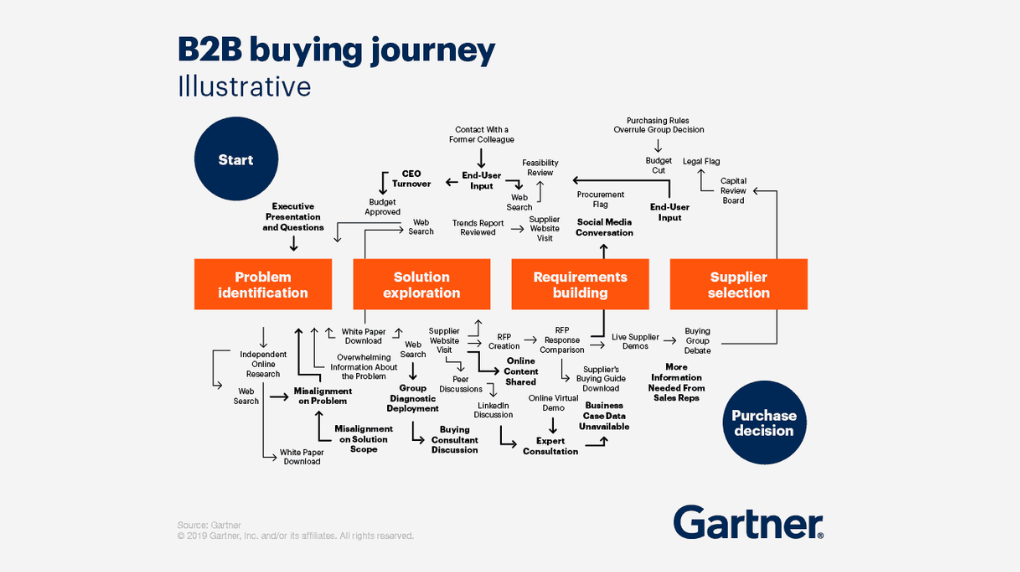
The customer journey was never linear, and it’s only gotten messier. Someone might discover your brand through paid media, come back through search, revisit the site later, and finally convert through a phone call that barely shows up in the attribution report, if at all. That kind of path happens all the time, in endless variations, which makes it much harder to understand performance as one connected system.
Then there’s automation. More decisions now happen inside platform algorithms that even experienced marketers can’t fully see. That can absolutely improve performance, but it can also make performance harder to interpret, explain, and learn from.
The same thing is happening across the rest of the marketing ecosystem. More formats, more channels, more platforms. Each one useful on its own, and each one creating more translation work between what the data says and what it actually means for the business.
In other words, marketing has become more capable and harder to read at the same time.
None of that was a mistake. These changes have expanded what marketing teams can do. But taken together, they’ve created something that behaves less like a tidy set of tools and more like a living system. Interconnected, always moving, and easy to misread when you’re only looking from one angle.
If you’ve walked out of a reporting meeting where everyone brought good data and still landed on different conclusions, you’ve already seen what that looks like in practice.
As Aaron Ward, Major Tom’s Media Director, puts it: “Scalable marketing isn’t about better ads. It’s about better internal clarity. Otherwise every decision feels like a gamble.”
The technical causes matter. But they’re usually not the part keeping marketing leaders up at night.
What lingers is something quieter. A slow drop in confidence.
Not confidence in the team, or even in the work itself. Confidence in being able to sit in front of a CFO or CEO and clearly explain what marketing is producing, why it matters, and why it deserves the budget behind it.
Most people in that position know the feeling. The data is ready. The slides are polished. On paper, everything looks solid. But the confidence underneath the numbers feels thinner than the deck makes it seem. Everyone in the room can sense it, even if nobody says it out loud.
When the system underneath your marketing isn’t producing real clarity, every budget conversation picks up a layer of uncertainty. Not enough to call the whole thing broken. Just enough to make the answers harder to stand behind.
And when that pressure builds, teams usually respond in ways that make sense. More reports. More proof. More evidence. But when the system itself isn’t connected properly, more evidence doesn’t create confidence. It usually just creates more noise.
That’s the real cost of the clarity gap. Not just murky metrics or messy reporting. A loss of confidence in what’s working, what deserves focus, and what you can credibly defend.
It usually doesn’t show up with a big flashing label that says “systems problem”. It shows up in smaller, more familiar ways. A conversation that drifts sideways. A decision that takes longer than it should. A result nobody can fully explain. But once you start noticing the patterns, they’re hard to ignore.
The dashboards don’t line up. Google Ads, GA4, and the CRM are all telling slightly different stories. Each number makes sense on its own. Together, they make something that should feel measurable start to feel debatable.
Budget conversations come with too much setup. The numbers need a long explanation before they hold together, and even then, the confidence behind them isn’t as strong as anyone wants it to be.
When growth slows, the instinct is usually to do more. More channels. More campaigns. More creative. Sometimes that’s necessary. Often, the real issue sits further upstream, but more activity feels easier than stopping to fix what’s underneath.
When performance drops, everyone starts looking sideways. Media points to strong platform results. Web questions the quality of the traffic. Creative says the brief kept changing. Analytics flags that the data was shaky from the start. Everyone is usually telling the truth about their part of the picture. The problem is that none of it adds up to a shared view of the whole.
Creative keeps getting revised. Not because the team missed the mark, but because the direction underneath the work wasn’t clear enough to begin with.
The website gets treated like a one-time project instead of an operating system. It gets scoped, launched, and mostly left alone until it starts to look dated or something breaks. What should be a source of ongoing learning and conversion optimizations turns into another big-ticket conversation every few years.
Any one of these on its own might just be a rough patch. But when several of them start showing up again and again, quarter after quarter, it’s usually pointing to something deeper.
If weak clarity tends to show up in patterns like these, the next question is usually the right one: where is the breakdown actually happening?
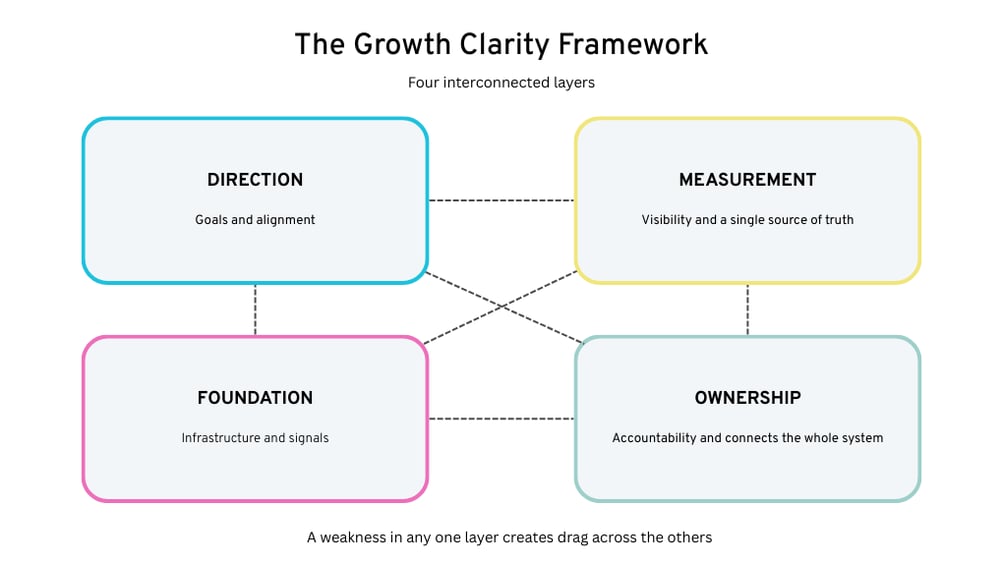
In practice, it’s rarely one tactic or one channel. Most organizations dealing with these symptoms are dealing with something broader: a system where clarity has started to erode across multiple layers at once. And when you try to fix each symptom in isolation, you usually end up with more activity, not more progress.
Here’s a simple test. Before your next planning meeting starts, ask each person in the room what marketing is ultimately meant to achieve for the business this year. Not campaign goals. Not broad aspirations. The actual business outcomes. Then count how many different answers you get. That number is often a pretty good indicator of how much alignment work still needs to happen.
That’s the thinking behind the Growth Clarity Framework. It’s not a process to follow step by step. It’s a way to look at the system as a whole. It focuses on four layers. Each one matters on its own. More importantly, each one affects the others.
Clarity often starts to break down in the simplest place: the direction the system is pointed in. Most marketing teams don’t have a shortage of goals. What they often lack is alignment on which goals matter most, and how those goals connect to what the business actually cares about. Growth targets, pipeline goals, brand initiatives, and channel metrics can all demand attention at the same time. Without a shared understanding of what marketing is really there to do, those priorities start pulling in different directions.
If direction defines where the system is going, the foundation determine whether it can actually get there. This includes the website, conversion architecture, martech stack, campaign setup, and the quality of the signals flowing through media platforms. A strong foundation doesn't just support what’s happening today. It makes it easier to test, learn, and improve over time. A weak foundation does the opposite. It absorb budget and effort without creating the feedback loop that makes the next decision smarter than the last.
Even when direction and foundation are solid, clarity can still fall apart in the way performance gets measured. The problem usually isn’t access to data. Modern marketing produces more of it than most teams know what to do with. The real challenge is making sense of it across systems that were never built to speak the same language. Platform dashboards, analytics tools, and CRM reports often tell slightly different versions of the same story. Each one may be technically right in its own context, but together they can create more ambiguity than clarity. Some marketers call this measurement debt: layers of reporting that describe activity without making decisions any easier. Strong measurement doesn’t remove uncertainty entirely. It creates shared confidence in which signals matter, and how to interpret performance when the numbers don’t line up neatly.
This is the layer that determines whether the other three can actually function as a system. Marketing involves a lot of contributors (internal teams, agencies, platforms, and partners) who all play important roles. But when accountability for the whole system is fragmented, the outcome usually becomes fragmented too. Media improves campaigns. Web improves site performance. Creative sharpens the message. Analytics interprets the numbers. Each function can do strong work in its own lane while the bigger picture stays difficult to hold together. Clear ownership doesn’t mean one person does everything. It means someone is responsible for connecting the parts and turning activity across channels into a coherent view of how the system is really performing.
These four layers don’t operate in sequence. A weakness in one creates drag across the others. Unclear direction makes measurement harder to interpret. A weak foundation limit what measurement can actually see. Fragmented ownership means that even when direction and measurement are strong, nothing gets acted on consistently enough to build momentum.
That’s why fixing one layer in isolation rarely resolves the frustration. The clarity gap is a systems problem. It needs a systems answer.
“Scaling media doesn’t fix weak strategy. It just makes the consequences show up faster.” — Aaron Ward, Media Director
When organizations start feeling the kind of friction described above, the instinct is usually to add more activity. Launch another campaign. Add another channel. Increase spend and try to turn things around. On the surface, the logic makes sense. If something’s working, do more of it. If results are underwhelming, push harder.
The problem is that scale doesn’t fix an unclear system. It exposes it.
Paid media is especially unforgiving here. Platforms are built to optimize towards the signals they’re given. But if those signals are weak, inconsistent, or disconnected from real business outcomes, more spend doesn’t create more clarity. It creates more noise, at a higher cost. A feedback loop that was already hard to interpret just starts moving faster than the team can realistically learn from.
The same pattern shows up well beyond media. Scale a website that hasn’t been built to learn, and you drive more traffic into an experience that still isn’t set up to convert. Scale creative across more channels without a clear strategic anchor, and you end up with more assets that still don’t add up to a stronger brand story. Scale reporting across more platforms, and you get more data that still doesn’t agree with itself.
As Aaron Ward says:
“Don’t use paid media as a band-aid. Eventually you realize you need to fix your website and your creative, and by then, you’ve spent a significant amount of time heading in a direction that didn’t build anything underneath.”
Scale is an amplifier, not a cure. Applied to a system with a strong foundation, clear direction, reliable measurement, and accountable ownership, it can compound growth. Applied to a system without those things, it compounds the confusion.
So before the question becomes how much to invest, there’s a more important one to answer first: is the system underneath ready to produce something worth amplifying?
When clarity comes back into a marketing system, the change usually isn’t dramatic from the outside. Campaigns still run. Teams still produce assets. Budgets still move through the same familiar channels.
What changes is how the whole thing works together.
The first shift is usually in the quality of decisions. Once there’s a shared understanding of what success actually looks like, trade-offs get easier to make. Direction stops changing every week. Teams stop reopening the same strategic debates in every planning meeting, and start building on what the last round already taught them.
.jpeg?width=1620&height=1080&name=Good-meeting-major-Tom%20(1).jpeg)
That accumulation is what separates a system that’s busy from one that’s actually learning. Creative gets stronger because it’s anchored in a clear strategic narrative. The website becomes a place where ideas can be tested quickly, and insights build over time instead of resetting with every new initiative. As Major Tom's Creative Director, Geoff Ravenor, puts it:
“The best creative work we do isn’t the most ambitious. It’s the work where everyone agrees on what we’re trying to say before we start saying it.”
Measurement changes too. Instead of producing three defensible versions of the truth, the system starts producing a smaller set of signals everyone agrees to trust. As Aaron Ward continues to say:
“Once clients have the right measurement infrastructure in place, you can see it in how they operate. They stop debating the data and start acting on it. The whole pace of the relationship changes.”
And maybe most importantly, marketing starts to feel different inside the business. It stops feeling like a cost centre that has to re-justify itself every budget cycle, and starts operating the way it should: as a system for generating and sustaining growth. That shift doesn’t usually come from results alone. It comes from being able to explain those results in a way the rest of the organization can actually understand and trust.
Clarity doesn’t remove complexity. It makes complexity easier to work with, and growth easier to repeat.
The clarity gap isn’t new. But it has become more consequential.
The organizations growing with confidence today aren’t always the ones with the biggest budgets or the fanciest tools. More often, they’re the ones that have done the quieter work of building clarity into the system itself. Getting aligned on direction. Strengthening the foundation. Connecting measurement to real decisions. Making sure someone is accountable for how the whole thing works together.
That kind of work rarely announces itself in a campaign launch or a quarterly report. But it shows up in the conversations. In the decisions that get made instead of delayed. In a marketing team that finally feels aligned, and can prove it.
The next piece in this series looks at what happens when organizations try to grow before that clarity is in place, and what it actually takes to get the system ready to scale. It's coming soon. Subscribe to Mercury below to get it when it drops.
The marketing clarity gap is the distance between how much marketing activity an organisation is running and how confidently leadership can explain what that activity is actually producing. It isn't a talent problem. It's a systems problem — one that tends to develop when direction, foundation, measurement, and ownership aren't aligned.
Because the environment has become more complex than most organizations were built to interpret. Customer journeys span more touchpoints, platforms automate more decisions, and performance data lives across systems that rarely tell a single coherent story. The challenge isn't a lack of data. It's turning fragmented signals into a confident explanation of what's actually working.
The Growth Clarity Framework is a diagnostic model for identifying where clarity is breaking down in a marketing system. It looks at four layers: direction (whether goals are aligned to business outcomes), foundation (whether the infrastructure can support growth and learning), measurement (whether performance data supports confident decisions), and ownership (whether someone is accountable for the whole system, not just individual channels).
Because data volume and decision confidence aren't the same thing. When reporting systems are disconnected or attribute performance differently, more data tends to produce more disagreement rather than more answers. The problem isn't evidence — it's that the system generating the evidence was never connected well enough to produce a single, trusted picture of performance.
Scale amplifies whatever the system is already producing. Unclear direction becomes more expensive confusion. A weak foundation sends more traffic into an experience that isn't ready to convert. Misaligned measurement creates larger disagreements at higher volume. Scale is an amplifier, not a cure — and it works best when applied to a system that's already producing clarity.
The clearest signals tend to show up in conversations rather than dashboards. Reporting meetings where different teams trust different numbers. Budget discussions that require extensive preamble before the figures make sense. Creative briefs that keep changing because the strategic direction underneath them wasn't settled. Websites treated as finished projects rather than systems built to learn. Any one of these might be a one-off. Several of them recurring across quarters usually isn't.
Be both a dreamer and a doer.