When you go looking for a marketing agency, which word is actually in your head: partner, or vendor?
Most of us reach for them interchangeably. But they aren't the same thing: each word describes a different relationship, and quietly, a different result. And most people never really choose between them. They hire expecting one and quietly get the other, and feel the difference long before they can name it. If you've ever felt vaguely annoyed that your agency does exactly what you ask and never a thing more, waiting for the next brief instead of bringing you the idea, that's the mismatch showing. It usually isn't a sign your agency is bad at its job. Its work is probably fine. It's a sign you're in a different kind of relationship than you thought you were buying, and the two kinds behave very differently once the work gets hard.
Choosing a marketing agency usually comes down to capability: who can do the work. The more useful question is what kind of relationship you're actually buying. A vendor executes deliverables on instruction, told what to do and accountable for tasks. A partner is asked how, not just told what: success is defined together, ownership of outcomes is shared, and accountability is clear enough that decisions get made and stick. The difference is structural, not a matter of effort or talent, and structure is what caps or compounds your results. If you want one diagnostic to carry into the decision, it's this: do we tell them what to do, or ask them how to solve it?
Start with the honest part, because it's the part most agency content skips: a vendor relationship can look completely fine from the outside. The work is competent. The reports land on time. The team is responsive and easy to deal with. Nobody is being let down on the deliverables, which is exactly why the problem is so easy to live with for years.
What's missing is harder to put on a status call. In a vendor relationship, you hold the strategy and the agency executes against it. "You're just the executor," is how Amanda Harvie, our Client Success Manager, describes being on the receiving end of it. "It's transactional. They see you as a checkbox on their to-do list." The work gets done, but the thinking stays with you.
Aaron Ward, our Media Director, draws the same line from the media side:
"The agencies that act more like vendors are really just focused on deliverables, whereas with us, we're really focused on business outcomes."
A vendor optimizes its own channel and reports on it cleanly. Whether the whole thing is actually working is treated as somebody else's job, usually yours.
So the tell isn't quality. It's that the relationship is reactive. It answers your briefs and it pitches you new services, but it rarely arrives with a problem you hadn't already spotted. You brief, it builds. You raise something, it responds. The direction always has to start with you, and over time that gets exhausting in a way that's hard to name in a renewal conversation.
A partnership changes the structure, not just the effort. A vendor is handed a task to execute; a partner comes in on the problem itself, shapes the solution, and runs it. Being asked how, not just told what, means the agency is expected to think, and to build the strategy with you rather than take it and hope.
The cleanest way Amanda puts it: "The vendor one is being told what to do, the partner one is being asked how to do it." That sounds like a small distinction. It isn't.
A few things follow from that. Success gets defined jointly, so you're both aiming at the same outcome instead of the agency quietly hitting a metric you'll later realize didn't move the business. Ownership of the result is shared, rather than parked entirely on your side of the table. And because it's clear who owns what, decisions get made and they stick, instead of stalling in a polite loop of "let us take that away and come back to you." None of that is automatic, which is why it's worth being deliberate about how you build the partnership itself, not just the scope of work.
Lyn Bryan, our President, is blunt about why this is the part that actually matters:
"Any good agency will produce great results. That's table stakes. But partnering with a group that you want to learn and grow with, and that you want to actually push the limits and test with, is different."
Capability is the price of entry. The relationship is the part that compounds, or doesn't.
This is where the distinction stops being abstract, because it's the question we hear from buyers more than any other: who owns what between my team, you, and our other partners?
Most mid-market marketing now runs through several specialists at once. A media agency here, a creative shop there, an SEO partner, a marketing-automation contractor, your own team somewhere in the middle. Each one can hit its own number and report a good month, while the outcome that actually matters, the one that spans all of them, goes unowned. That space between partners is where performance quietly disappears, and it never shows up on any single scorecard because every scorecard is green.
A vendor will show you its KPI and stop at the edge of its scope. A partner will tell you what it's accountable for beyond its own lane, and who should own the rest, including work it isn't being paid for. That's the difference between someone optimizing a channel and someone accountable for the whole system, not just a channel. Here's the honest test: if nobody in your current setup can answer "who owns the result," you don't have a partner yet. You have a group of vendors and a coordination problem that keeps landing back on you.
None of this is about how hard anyone is working. It's about what each structure makes possible, and three mechanisms do most of the work.
When no one owns the whole, blame has somewhere to hide, and good ideas die in the gap. Amanda describes what that looks like inside a client's world: "everyone's just kind of throwing things at a wall, hoping someone catches it." Without clear accountability, there's no one to carry an idea from "good in the meeting" to "live and actually working," so it quietly doesn't happen. A partnership settles the ownership question first, because almost everything else depends on it.
This is the one buyers actually leave over, and it's worth being precise about it. When brands change agencies, the reason usually isn't bad work. It's that the agency executed the brief it was handed and never told them what to stop doing. A partner names the real problem before being asked. A vendor waits for the brief. If you've been the smartest person in the room about your own marketing, this is the mechanism you've been missing, and it isn't a talent gap, it's a structural one.
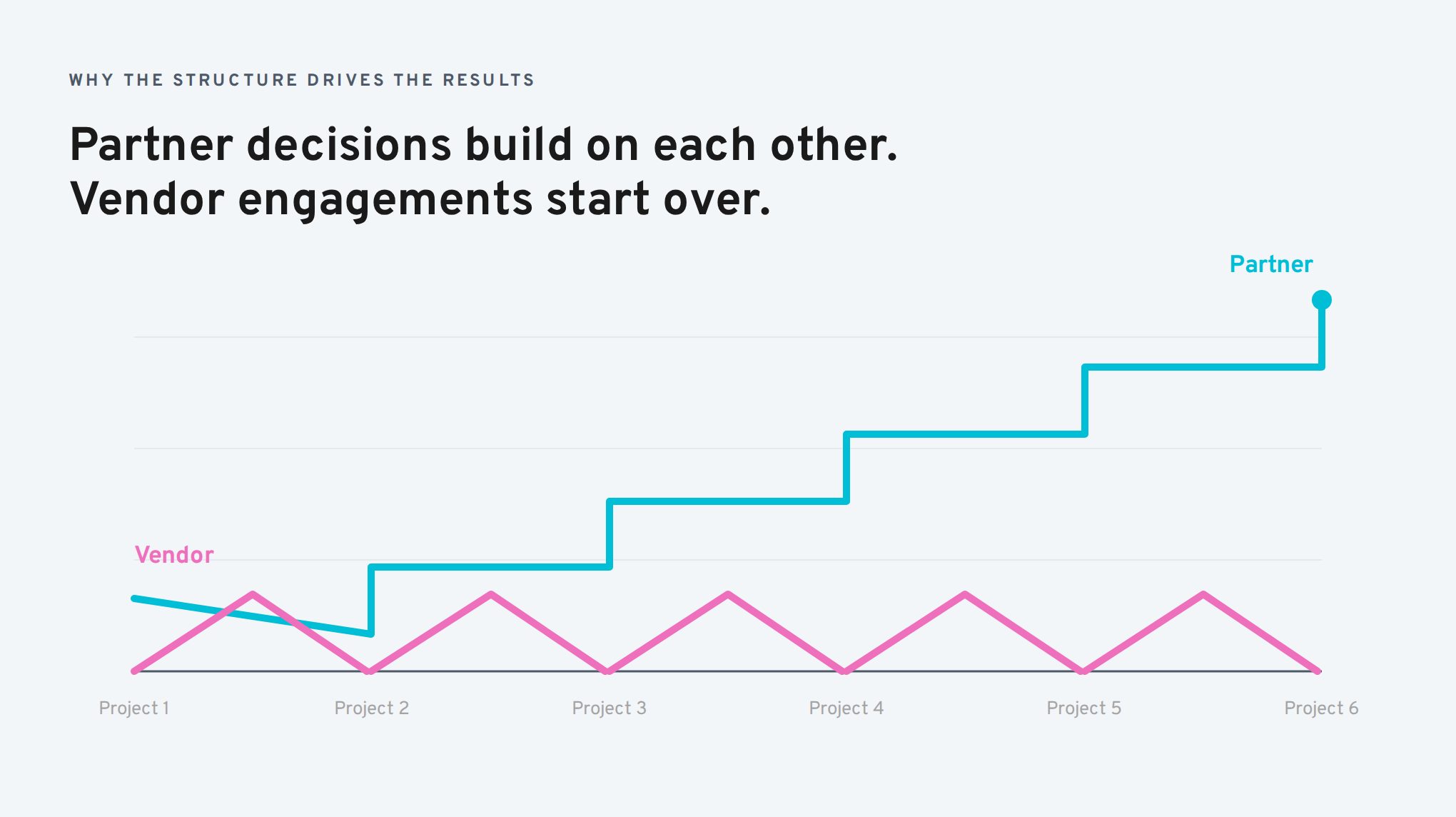
Partner decisions stick, so they build on each other. Vendor engagements reset, because each project gets renegotiated from scratch and nobody's carrying the thread between them. That matters more the less time you have, and you have less than it feels like: the average CMO now lasts a little over four years, so a relationship that takes a couple of quarters to start compounding has to be chosen on purpose, not drifted into. It's the same order-of-operations point we make about scaling, applied to the relationship itself: get the structure right, then let it compound.
You tell them apart by who drives the relationship, not by whether the work is good. Run your current agency through a short, honest self-assessment: a handful of questions, none about deliverable quality, because quality is rarely the problem.
Who spotted the last real problem, them or you? The single most useful question, and the hardest to dodge. If every issue in the past year started with you, you're in a vendor relationship, however warm it feels.
Do you tell them what to do, or ask them how to solve it? A partner wants a say in the approach. A vendor waits for the instruction and delivers to it.
Is success defined together, or handed over? If you set the target alone and the agency reports against it, that's a vendor arrangement, whatever it's called on the contract.
When something underperforms, does someone own it, or does it circulate? Watch what happens on a bad month. Ownership is a partner tell; a round of channel-by-channel deflection is a vendor one.
Does anyone own the whole, or only their channel? Someone has to be accountable for the outcome across everything, not just their slice of it.
Are the people who pitched you the people doing the work? Ask who's on your calls after month three, and get names, not roles. Vague answers here are the most reliable early warning there is.
Then the honest part. If what you want is a vendor, that's a legitimate choice. Some work is well-defined enough that you just need it executed well, and a vendor is often cheaper. The only real mistake is buying a vendor while expecting a partner's outcomes.
And since we've handed you the lens, it's only fair to say where we stand: Major Tom is built for the partnership, the uncommon kind where we're invested in your business outcomes alongside you, not just a deliverables checklist. If a pure vendor is what you need, that's a completely fair call, and we're honestly not it.
So, back to the word you started with. You can see the difference now, which means the only question left is which one you actually need. It's worth finishing the sentence honestly before you sign anything: what we need is a ______.
A vendor executes deliverables on instruction: told what to do, accountable for tasks, optimizing its own channel. A partner is asked how, not just told what: success is defined jointly, ownership of outcomes is shared, and accountability is clear enough that decisions get made and stick. The difference is structural, not a difference in competence, and the structure is what caps or compounds performance over time.
Ask who is in the room after month three, and get names rather than roles. Ask which of the people pitching will be on your weekly calls, who makes the call when something needs escalating, and what happens to your account when someone leaves. A partner will answer specifically, because the structure is already decided. Vague answers here are the most reliable early warning available.
More than a vendor relationship early, and less later. A partner needs access to your context, your data, and the people who make decisions, which is real time in the first weeks. A vendor needs only a brief. That front-loaded cost is what buys you an agency that can diagnose rather than execute, but it's a genuine cost, and it's worth naming before you commit rather than discovering it in week two.
You should, and you should confirm it in writing before signing. Ownership of ad accounts, analytics properties, tracking configuration, historical data, and creative files is a concrete trust signal precisely because it costs the agency its leverage. An agency confident in the relationship has no reason to hold your platforms hostage. This one question separates partnership language from partnership structure faster than any other.
Look past capability, because good results are table stakes. Look at relationship structure: does the agency diagnose the real problem before proposing work, share ownership of outcomes, and stay accountable for the whole rather than their channel? Those traits predict compounding performance far better than any single deliverable or polished pitch.
Yes. If you need execution of a well-defined task and you have the internal capacity to direct it, a vendor is legitimate and often cheaper. The mistake is buying a vendor while expecting a partner's outcomes. Know which relationship you actually need, and choose the structure that matches it.
Innovation is where good marketing begins