For over a year, the plan was simple. Our founders would personally work through our dormant lead database: 20 contacts each per week, three of them, 60 a week total. Clean and doable, right?
Here's what actually happened: each of us would reach out to four or five close personal connections, get a coffee meeting, feel good about ourselves for a week, and then get buried in client work. Rinse and repeat. Those personal reach-outs converted brilliantly and because they were warm, and because they were us. But after a year of conversations about the bigger project, we had basically nothing to show for it.
Meanwhile, roughly 7,000 dormant contacts, leads who had previously reached MQL or SQL status and then gone quiet, just sat there. Not because they weren't worth pursuing. Because we had no realistic way to pursue them at the quality they deserved.
When we ran HubSpot's Breeze Prospecting Agent on 1,000 of those contacts this spring, it booked 24 meetings, generated over $750,000 in proposals, and closed a $200,000 enterprise deal. All within the first month. HubSpot took notice, and published a full case study on the campaign: How Major Tom Reconnected With 1K+ Businesses and Closed a $200K Deal with Prospecting Agent.
Here’s our account of what actually happened, why it worked, what went wrong, and what it might mean for your own CRM.
Most B2B companies have a version of this problem. Contacts accumulate in the CRM over years. People who once raised their hand (downloaded something, filled out a form, took a meeting) go quiet. Not because they stopped having needs. Because life moved on, priorities shifted, and no one followed up in a way that felt relevant to where they were now.
The standard industry response is to either ignore those contacts or blast them with a generic re-engagement campaign that reads like it was written for everyone and, as a result, lands for no one.
Our dormant contacts deserved better than that. These were previously qualified leads. Some of them had been in active conversations with us years ago. The ones who converted into clients had stayed with us for an average of two and a half years. The ones who went quiet had simply never received outreach that was worth responding to.
That's a sales motion problem, not a database problem. And it's the same problem we see in a lot of our clients' organizations: the contacts exist, the relationship history exists, the potential is there, but the capacity to act on it at scale, with any consistency or quality, is not.
HubSpot's Breeze Prospecting Agent is a native AI sales assistant built directly into Sales Hub. That last part matters more than it might seem. It's not a third-party tool bolted onto your CRM, it lives inside HubSpot, with direct access to your contact records, deal history, company data, email engagement history, and sequences.
Its job is to identify promising contacts, research them using enrichment data, and generate personalized outreach drafts for a human to review before anything sends.

Chris Breikss, our co-founder and growth lead, had run a small test of Breeze at Rivetline (our sister agency focused on AI-powered sales systems) before bringing it to Major Tom. He loaded 200 of his own contacts and didn't expect much. "The quality is 300% better," he said after seeing the results. "It's better than what I could write."
That's not a product endorsement. That's a specific observation about what happens when an AI tool has a decade of CRM context to draw on rather than a blank form to fill out. The emails Breeze generated weren't impressive because the AI was clever in isolation. They were impressive because they referenced each contact's actual history: pages visited, forms filled out, prior conversations, industry signals. Most of the recipients who responded thought a human had written it personally.
What Breeze does not do: fix a messy CRM, replace a defined ICP, or compensate for a sales process that doesn't exist yet. We'll come back to that.
We were not starting from scratch. Major Tom has been on HubSpot for over a decade across sales, marketing, and service, fully integrated as our RevOps layer. Our original rep, Julie Rosenthal, who recently retired into the HubSpot Hall of Fame, worked with our team for years. That kind of long-term partnership is part of why we were ready when this tool came along.
Lifecycle stages were set properly. Company records were linked to contacts. Historical engagement data was intact. That maturity is the reason this test was possible at all.
Setup for Breeze itself took about two hours. Most of that time went into giving it enough context to actually sound like us:
Brand kit: We uploaded our voice and tone guidelines, positioning, and messaging pillars so Breeze could represent Major Tom accurately rather than default to generic agency-speak. If you skip this step, the output sounds like it could belong to any company. Which is to say, it sounds like nothing.
ICP criteria: Detailed profiles of our ideal prospects: industry, company size, revenue range, the services they typically need, and the specific job title and interests of the person we most want to reach. Specific enough that Breeze could distinguish between a contact worth prioritizing and one worth skipping.
Services context: What we sell, how we position each service, and what problems we're actually solving for which kinds of clients.
Enrichment and approvals: Connected data sources for real external signals, and a human approval workflow so nothing sent without a rep signing off. That last piece is not optional, especially early on.
One decision that probably shaped our results more than anything else: we did not run Breeze on all 7,000 dormant contacts. We segmented down to 1,000 who had previously hit MQL or SQL status. These were not random cold records: they were leads who had once been qualified and simply gone quiet. That distinction matters enormously when you're interpreting what came next.
One small detail worth sharing: we had a whole rollout plan in progress and were set to launch the following Wednesday. Then on a Thursday afternoon we looked at the config, looked at our reps' calendars, and thought: what exactly are we waiting for? We pulled the trigger that afternoon. Worst case, we would catch issues in week one and fix them. Best case, we would be five days ahead. We ended up being five days ahead.
|
Factor |
Manual Outreach |
Breeze AI-Assisted (Our Campaign) |
|
Research time per contact |
5 to 10 minutes |
~30 seconds (review only) |
|
Contacts engaged (first month) |
Limited by rep bandwidth |
1,000 previously qualified dormant contacts |
|
Meetings booked |
Typically a handful on a dormant list |
24 |
|
Pipeline value generated |
Bounded by volume |
Over $750,000 in proposals |
|
Deals closed from campaign |
N/A |
1 enterprise deal, $200,000, within first month |
|
Total sales activity lift |
Baseline |
More than doubled |
|
Active pipeline lift |
Baseline |
~30% increase |
|
Error or complaint rate |
Varies, opt-outs routine |
Under 1% of contacts reached |
|
Personalization quality |
High when done well |
Good, higher than expected |
|
Consistency across reps |
Varies significantly |
Consistent baseline quality |
|
CRM hygiene byproduct |
None automatic |
Surfaced dozens of stale records |
|
Weak spot |
Speed and consistency |
Stale data, review bottleneck |
*Source: Major Tom internal campaign data, as published on Rivetline.ai
The numbers are real, and they're worth stating plainly: 24 meetings booked, over $750,000 in proposals, one $200,000 enterprise deal closed within the month. Active pipeline up about 30%. Overall sales activity more than doubled.
Each of the 1,000 contacts went through a five-touch sequence over roughly 30 days, business days and business hours only, emails written fresh from the contact record rather than templated follow-ups. Approximately 5,000 individualized emails in total.
The thing that shook us most wasn't any single metric. It was the comparison to what we'd been doing before. Three founders, a year of conversations about working the dormant list, and almost nothing to show for it. Breeze did in one month what we had been failing to do manually for twelve.
That's not a case for replacing your sales team. It's a case for stopping to ask what work only humans should do, and building systems to handle the rest.
Here's the thing we want every sales leader to internalize.
Standard practice when an email bounces with a "no longer with the company" reply: mark the contact gone, note it in the CRM, move on. What we did instead: treated the bounce as a signal.
About 10% of our outreach bounced. For each one, our sales rep would find out who had replaced that person, add them to HubSpot, and reach out with something like: "I understand Mark Johnson is no longer with the company. We were in conversation with him a few years ago — who's picked up that thread now, and how is your marketing going in general?"
A lot of those messages got forwarded internally, often landing with a new CMO or founder who had never been in our pipeline before. Bounces stopped being a cost and started being a top-of-funnel opening.
If your CRM is a few years old, you have this opportunity right now.
Our sales reps caught issues early that traced back to our own data, not Breeze. Job titles that had changed. Companies that had restructured. Contacts who had moved on entirely. Data hygiene problem, not a tool problem but it would have been a real problem if the reps hadn't been in the review loop.
We also got feedback from one or two prospects that the cadence felt too aggressive. We'd had Breeze reaching out every two days. We pulled it back to twice per week and the friction disappeared. The lesson: AI will do exactly what you configure it to do, including things you would never do yourself if you were paying attention. Watch the cadence.
And when we paused the campaign mid-run to recalibrate, some contacts queued just before the pause went out with stale timing after restart. A small number slipped through before anyone caught it. That's now in our playbook: always review the queue before restarting.
Overall, errors and negative responses tracked under 1% of contacts reached. For a campaign this size on a dormant list, that's a strong number. But under 1% is still real people, and a handful required personal follow-up. Go in with that expectation.
The Breeze campaign did something we hadn't fully anticipated: it told us more about the health of our own database than any manual review would have. Stale records surfaced. Contacts who had left their companies were identified early. What looked like a lead re-engagement campaign turned into a database audit.
If your CRM has been accumulating contacts for a few years without regular hygiene, this is worth knowing before you assume those records are usable. Breeze accelerates what's already there - the good and the bad.
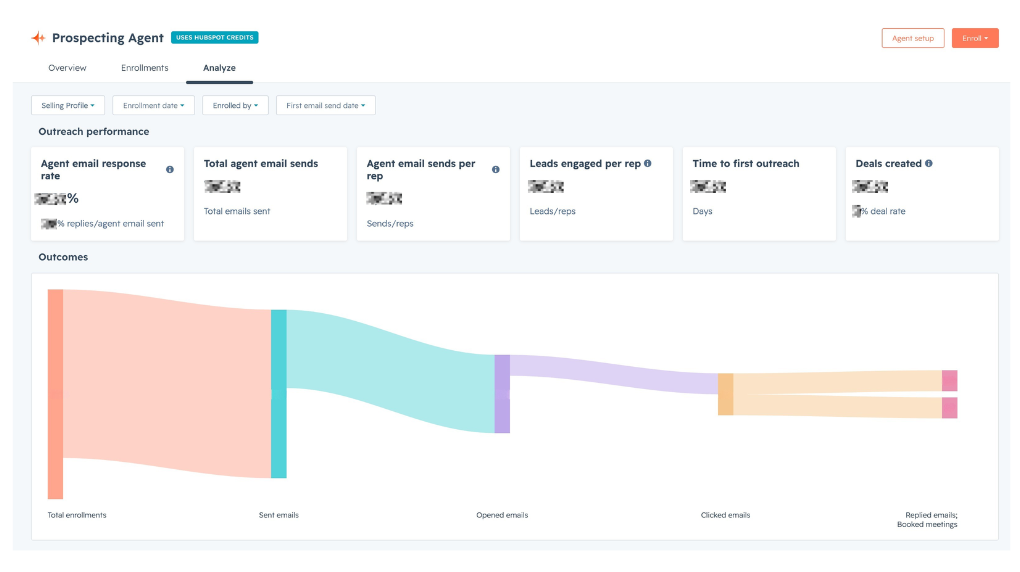
A few honest conditions for this working at your organization:
The platform investment has to be there. Breeze worked on day one for us because our HubSpot instance reflected 12+ years of structured use. If your CRM is six months old and half-configured, plan on a longer runway before you see numbers like ours.
A defined ICP is not optional. Generic input produces generic output. If you can't describe your ideal prospect in specific enough terms that a tool could distinguish them from a non-ideal prospect, that's the work to do first.
Keep a human in the loop, at least at first. Our sales reps pushed back on targeting in week one, and they were right. That human check is what separates a well-run AI campaign from one that sends the wrong message to the wrong person at the wrong time.
One person at Major Tom is now nearly fully dedicated to running Prospecting Agent. A role that didn't exist three months ago. Our sales reps who used to spend their days grinding through cold follow-ups are now spending that time on conversations that are further along and better qualified. Budget conversations come later in the process. Discovery happens earlier. Clients arrive already having signaled interest.
That shift in how the team operates is, in some ways, more significant than the pipeline numbers.
Chris put it directly when the team raised questions early on about what this meant for them: reps would be the operators of the tool, not replaced by it. The rep who once spent 15 minutes researching a contact before writing an outreach email now spends that time on strategy. The rep who once chased unresponsive leads now fields calls from prospects who are already thinking about the problem we can solve.
The 7,000-lead backlog is still being worked through. The plan is to scale Prospecting Agent across the full database as we continue refining the approach.
For the full external account of the campaign, including HubSpot's perspective on the results and how the re-engagement engine was built, the case study is here: How Major Tom Reconnected With 1K+ Businesses and Closed a $200K Deal with Prospecting Agent.
One thing worth stating plainly: Major Tom is not a paid HubSpot advocate. We are a long-time customer who built our business on this platform, and we are sharing this because it worked, not because we were asked to. The numbers above are real. The mistakes are real. And Breeze Prospecting Agent, used properly, is the closest we have seen an AI tool come to earning a genuine seat on a sales team.
If your organization is sitting on a similar backlog: qualified leads who went quiet, a sales motion that isn't scaling, or a HubSpot instance that's never been fully activated, we're happy to talk through what that looks like in practice.
Breeze Prospecting Agent is part of Sales Hub. Availability depends on your tier, and the feature set continues to expand as HubSpot develops the Breeze suite. Check your current plan or speak to your HubSpot rep, as access and functionality have been updated regularly since launch.
We saw meetings booked within the first few weeks, but we were working with a mature HubSpot instance and previously qualified contacts. If your CRM needs cleaning, your ICP needs defining, or your team needs time to build a review workflow, factor that into your timeline. The setup itself took us about two hours. The preparation that made the setup work took over a decade.
Not necessarily, but you need the right contacts more than you need a lot of them. We segmented down to 1,000 from a pool of 7,000 specifically because quality of targeting matters more than volume. A smaller, well-qualified list will outperform a large, messy one every time.
A traditional sequence sends the same templated emails to everyone in a list on a fixed schedule. Breeze pulls from your CRM history, enrichment data, and the context you feed it to write fresh, individualized emails for each contact. The recipient experience is closer to getting a thoughtful note from someone who did their homework than receiving a drip campaign. That difference is what drove our response rates.
It depends more on CRM maturity and ICP clarity than company size. The conditions that made this work for us were a clean, well-structured HubSpot instance, a defined ideal client profile, and experienced sales reps available to review output and handle responses. Those conditions are achievable for a range of company sizes. What doesn't scale down is a messy database or an undefined target -- Breeze will accelerate whatever is already there, good or bad.
No, and we'd push back on any framing that suggests it does. One person on our team is now nearly fully dedicated to operating Prospecting Agent -- reviewing drafts, managing responses, refining inputs. The tool shifted what our sales reps spend their time on, not whether we need them. Discovery happens earlier, budget conversations come later, and reps are handling warmer conversations rather than cold follow-up. That's a better use of sales talent, not a replacement for it.
Opt-out and unsubscribe requests run through HubSpot's standard compliance infrastructure. Anyone who responded negatively was removed from the sequence immediately and flagged for a rep to handle personally where needed.
Yes. If you're trying to figure out whether your HubSpot instance is ready for something like this, or where the gaps are, that's a conversation worth having.
Obstacles are like asteroids. Shoot 'em down and let's go to the moon.