Holiday ad budgets aren't exactly short of places to go. Now ChatGPT wants a share. On November 4, OpenAI held its first holiday webinar for brands buying ChatGPT Ads, and our media team watched it with the question you're probably weighing for your own plan: is ChatGPT worth some of this season's budget, and how would you test it so the result actually tells you something?
Our answer is yes for brands whose customers research before they buy, as long as the test is big enough to learn from and the money wouldn't do more in channels already working for you. Before you launch, check one setting. Since October 30, ChatGPT's AI creative enhancements have been switched on by default for self-serve campaigns, which lets the platform rewrite your ads and change where they send people unless someone on your team has opted out.
ChatGPT Ads are worth a holiday test for brands whose customers research before they buy, provided the budget buys enough impressions to learn from and wouldn't do more in channels that already work. Judge the test on what it adds to the business, using ChatGPT's own conversion reporting as one input rather than the verdict. Treat AI creative enhancements as a decision: they've been on by default for self-serve campaigns since October 30, and they can change your copy and landing page without anyone approving each version.
Holiday shopping research is moving into AI conversations, and the people having them are close to buying. Adobe expects traffic from AI services to US retail sites to rise 130% year over year this holiday season. ChatGPT Ads let a brand appear inside those conversations while the decision is still forming, instead of hoping an AI answer sends someone its way.
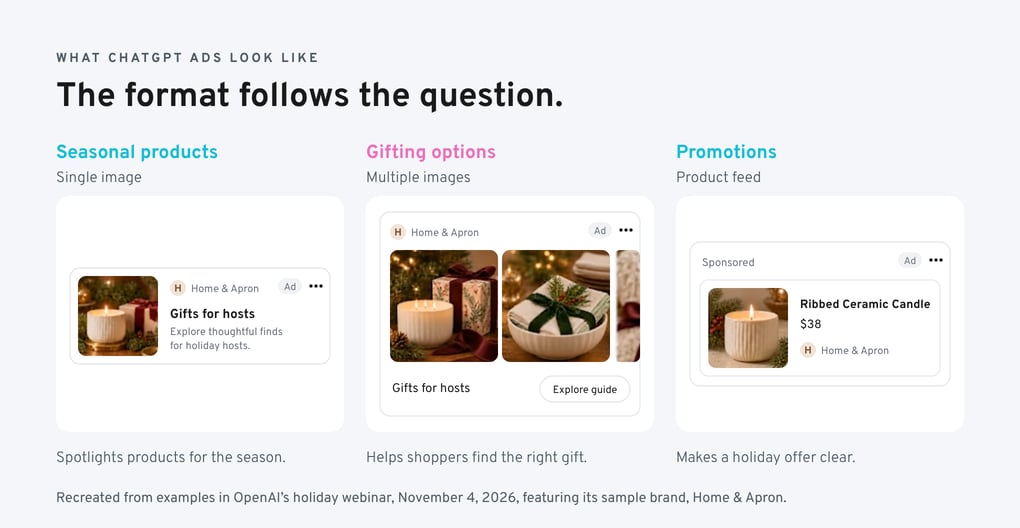
The ad's format can change with the question, as the examples OpenAI shared in its webinar show.
Those visitors are worth having. Last holiday season, Adobe found that shoppers arriving from AI services converted 31% more than shoppers from other traffic sources, spent 45% more time on site, and were 33% less likely to leave immediately.
Adobe is counting people who clicked a link inside an AI answer, from any AI service. They're organic referrals. Nobody knows yet whether people who click a ChatGPT ad will behave the same way, which is one more reason to treat this season as a test.
None of this means Google is losing its audience. Alphabet's third-quarter results put Google's query growth at its highest in five years, which Sundar Pichai credited to the company's AI investments. What's changing is where research happens. More of it now takes place inside an answer, on ChatGPT and on Google alike.
Allen Liu, our media manager, draws a useful line between ChatGPT and the other ad-supported platforms in a typical media plan. In his view, Spotify and YouTube ads mostly build awareness, while someone researching a purchase in ChatGPT already has intent, so an ad there can carry them toward a decision much faster. OpenAI shared US data in its holiday webinar that points the same way: product research in ChatGPT was already elevated in the weeks before Cyber 5 last year (the five days from Thanksgiving to Cyber Monday), and it rose again through Black Friday.
ChatGPT Ads make the most sense for brands whose customers compare and research products before buying, and who can measure a new channel well enough to learn from it. The budget matters as much as the fit. A test should run on money your proven channels can't put to good use.
Gifting is a natural fit, because comparing options is exactly what people use ChatGPT for. The best candidates also sell often enough to produce a readable number of conversions in a few weeks, and keep their product information accurate enough for the platform to draw on. A considered purchase with a months-long decision cycle may belong here eventually, but a holiday test won't tell you much about it.
The budget condition is the one most likely to rule a test out. If a search or shopping campaign is already limited by budget during peak weeks, moving money out of it has a real cost, even if ChatGPT works. Lyn Bryan, our president, sees the same risk whenever a plan tries to cover more channels than its budget can support:
"The strategic recommendation is to do one and do it well, so you can actually make an impact, instead of being so watered down that your spend isn't going to do anything."
That doesn't rule ChatGPT out. It means the test should run on spare budget, or on a deliberate decision that learning about ChatGPT now is worth a little less return somewhere else.
A ChatGPT Ads test should be big enough to buy a readable number of impressions every day, and that depends on your CPM more than on the platform's minimum budget. Start with the smallest amount that produces meaningful delivery, and add budget only where the results hold.
Allen's version get's straight to the point:
"Start small, but small in a way that actually makes sense and would do something. If the CPM is $10 and you're getting 2,000 or 3,000 impressions a day, that's not a lot to go on."
It's worth doing the arithmetic before anyone sets a number. Daily impressions are your daily budget divided by the CPM, multiplied by 1,000. The CPMs below are only there for illustration. Use whatever your own campaign shows after its first few days of delivery.
| Daily budget | Impressions a day at a $10 CPM | At a $30 CPM | At a $60 CPM |
|---|---|---|---|
| $25 | 2,500 | about 830 | about 420 |
| $100 | 10,000 | about 3,300 | about 1,700 |
| $250 | 25,000 | about 8,300 | about 4,200 |
Then sanity-check it against what a thousand impressions produces in your paid social or display campaigns. ChatGPT reaches people in a different frame of mind, so treat that as a rough check rather than a forecast. The only question is whether this delivery could plausibly produce enough sales to read before Cyber Monday. If the honest answer is a handful, the test can't tell a good week from a lucky one, and you'll finish the season with an opinion instead of a result.
OpenAI suggests reviewing campaigns every two to three days, and was clear that checking in doesn't mean changing something each time. Allen agrees with the cadence. Where results are strong, add budget in steps, because scaling before you can read the results tends to magnify whatever isn't working yet.
Keep the test in proportion, too. Allen's advice to anyone trying ChatGPT this season is to be open to it and see how it performs. Just don't let it be "the only horse you're betting on, so that you can pivot." If your holiday plan has no room for a test that might not pay back this year, skip it for now.
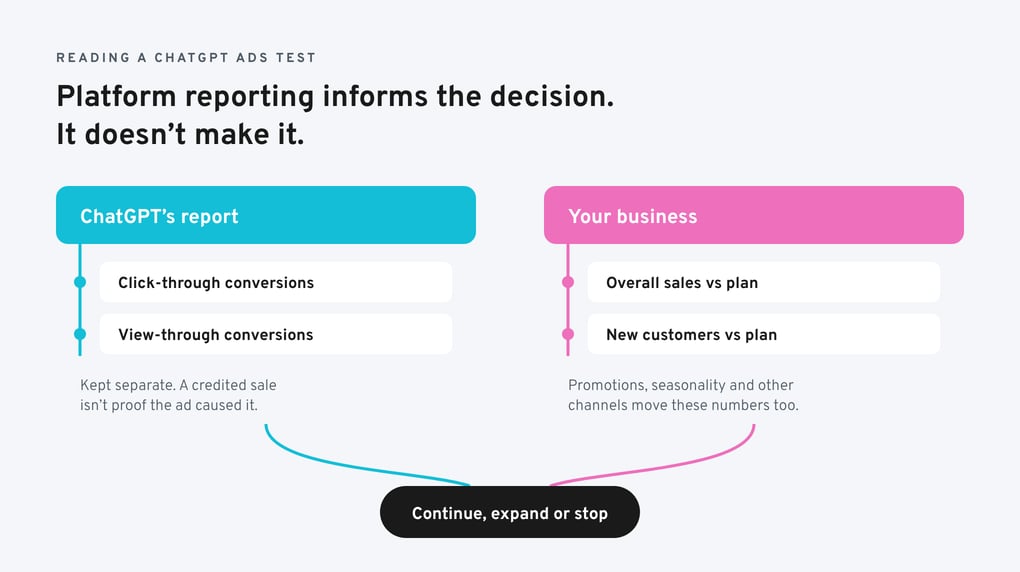
A successful ChatGPT Ads test shows the channel adding sales or new customers at a cost you'd pay again. ChatGPT's own reporting, including sales from people who saw an ad without clicking it, should inform that decision without making it. A sale the platform credits to an ad isn't proof the ad caused it.
OpenAI recommends a conversion objective billed on impressions for holiday sales, and in the webinar it said more than half of eligible view-through conversions (purchases by people who saw an ad but didn't click it) happen within an hour of the ad appearing. Because people tend to finish their research inside ChatGPT before they visit a site, a report built only on clicks will undercount the channel.
Allen put it this way when we talked the webinar through:
"Just because someone didn't click into the ad doesn't mean it didn't start influencing them. When you're having a conversation with ChatGPT, you're trying to get to the bottom of something before you start clicking into products. If we rely only on interactions with the ad, we're missing out on how effective this could be."
That's a good reason to count view-through sales, and a poor reason to treat every one of them as extra. Someone who saw your ad an hour before buying may well have been on their way to buy anyway. Attribution tells you where the platform's credit landed. It doesn't tell you what the business gained.
So read the test on two levels. Start with ChatGPT's attributed conversions, with click-through and view-through split apart. Then compare overall sales and new-customer acquisition during the test with your plan for those weeks, remembering that promotions, seasonality and your other channels move them too. If your volume allows it, running the test in some regions and holding it back in others gives you a cleaner comparison.
All of this depends on clean conversion data. ChatGPT Ads record purchases through a pixel on your site, a Conversions API connection from your backend, or both, and Ads Manager rates what you send with an Event Quality Score from one to 10, updated daily. OpenAI said advertisers with high scores saw lower measured costs per acquisition than their peers, an observed pattern rather than a guarantee. If your tracking already carries some measurement debt, a new channel will inherit it, and you'll be defending numbers you don't fully trust.
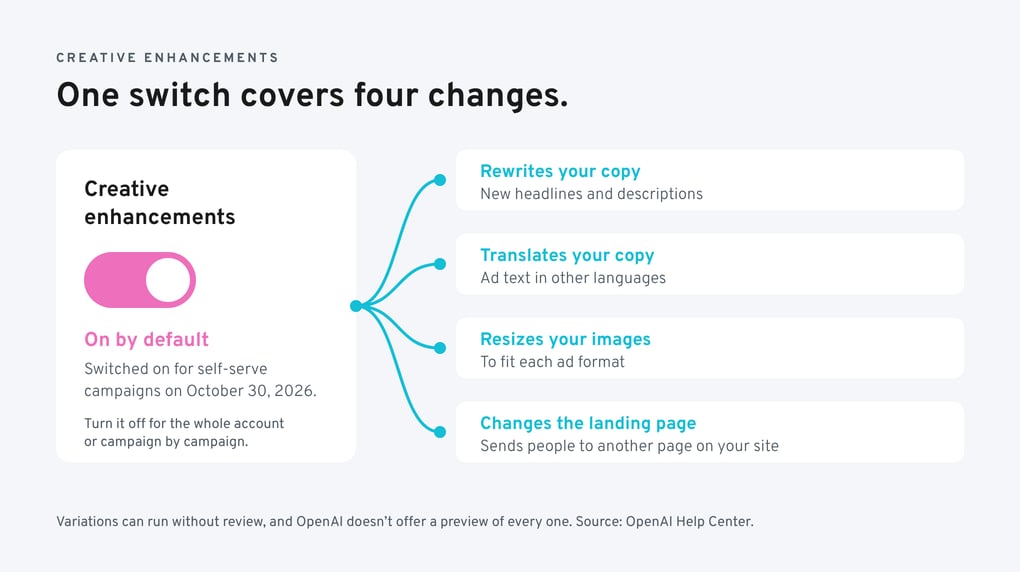
If you buy ChatGPT Ads through the self-serve Ads Manager, its AI creative enhancements are probably already on. Since October 30, OpenAI has switched them on by default for new and existing self-serve campaigns, keeping any earlier opt-outs. Testing them can make sense, but your team should make that call deliberately, and campaign settings override the account default.
OpenAI's help center describes one setting that covers four kinds of change: rewritten headlines and descriptions, translated copy, resized images, and a different destination page on your site. Variations can be prepared in advance or created in real time from the conversation, and they can run without anyone reviewing or approving each version. OpenAI doesn't offer a preview of every variation.
It's an easy change to miss, especially for campaigns set up before October 30. OpenAI's November 4 webinar encouraged advertisers to keep creative enhancements on so the system can adapt their copy to each conversation, and for some brands that's the right call. It just needs to be a choice your team makes on purpose.
We'd hold ChatGPT to the same standard we set out for Meta: know which AI features are on and what they can change, then decide whether that level of control is acceptable for your brand. ChatGPT being an AI product from the start doesn't change who customers hold responsible for an ad. Your brand is the one on it.
Keep them off where exact wording matters, such as a regulated claim or a promotion with fine print, or where your brand has made public commitments about AI. The destination change matters too. If some pages on your site shouldn't receive paid traffic, that's another reason to leave the setting off, because one switch covers everything.
Test them where your product information is accurate and your brand can live with some variation. Check the ads that run and the pages they land on during the first week, and switch the campaign back to manual ads if anything doesn't sound like you.
Either way, the platform works from what you give it. OpenAI says its ad system treats your site as an important source of context, so keep product and landing pages crawlable and current, the same work that makes your site readable by AI systems in organic answers. If you sell products, keep the feed current too. By OpenAI's own comparison, feed campaigns saw better click-through rates, and over the holidays the ad will show whatever the feed says.
Start now if your tracking works, your customers research before they buy, and your proven channels aren't short of budget. Thanksgiving is November 26, so a test launched this month will still be learning over Cyber 5. If you can't launch with clean measurement, wait for Q5. If your existing campaigns still need the money, skip this season.
Start now. Campaigns need time to learn from your conversion data, which is partly why OpenAI urged advertisers to start early. Judge Cyber 5 on what the campaign contributes, knowing it won't be at full strength yet, then treat January as additional learning from a different shopping period rather than a verdict on Cyber 5.
Wait for Q5. OpenAI also urged advertisers not to forget Q5, the stretch from Christmas into early January, when people come back to ChatGPT planning new routines for the year or looking for post-holiday offers. Use December to get your tracking and product feed right, then launch late in the month.
Skip this season if your proven channels still need the money, or if you can't measure a new channel yet. You can revisit it next year with better data.
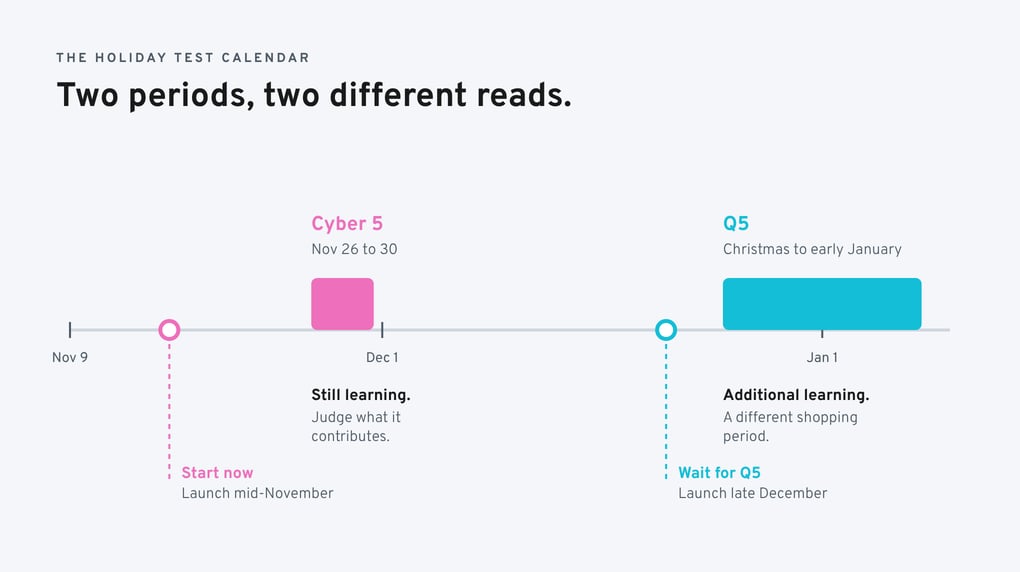
Either way, keep the two periods separate. Cyber 5 tells you what ChatGPT added to your peak, and January tells you how it performs once the rush is over. Neither is a forecast for next holiday season, but together they give you a starting point.
Most of this is the discipline any new channel deserves. The more of the execution ChatGPT takes on, the more your results depend on the decisions it can't make for you, starting with whether it deserves the budget at all. If you'd like a second opinion on whether ChatGPT belongs in your holiday plan, or how to size the test, our paid media team is happy to talk it through.
Businesses buy ChatGPT Ads either self-serve through OpenAI's Ads Manager or through OpenAI's sales team and partners. Search Engine Journal reported that self-serve access opened to US advertisers in May 2026, and it has expanded since. OpenAI's Ads Manager availability list shows which markets can buy self-serve, the US and Canada among them. Check your market before you plan a budget, and leave time for account setup before your launch date.
ChatGPT Ads are sold through an auction, and you choose what you pay for. When OpenAI opened Ads Manager, Search Engine Journal reported that it offered buying by impressions (CPM) and by clicks (CPC). For holiday sales, OpenAI's webinar recommended a conversion objective billed on impressions with automatic bidding, plus an optional target cost per acquisition as a guardrail. OpenAI is also offering holiday ad credits to eligible new advertisers through December 31. Check the CPM your first few days of delivery show before committing the full budget.
ChatGPT Ads are matched to the topic of the conversation they appear in and shown at the bottom of it, TechCrunch reported when OpenAI announced the program, and users can see why an ad was shown and turn off personalization. OpenAI's ad system also uses your website as context for relevance, so pages that clearly explain what you sell and who it's for give the platform more to match on.
ChatGPT shows ads only to people on its Free and Go plans, the same model Spotify and YouTube use to keep ads off their paid tiers. Plus, Pro, Business, and Enterprise users don't see them, as TechCrunch reported at launch. Most people don't pay: in February, OpenAI put ChatGPT at 900 million weekly users and 50 million paying subscribers. If your buyers mostly use a company Business or Enterprise seat, though, your ads won't reach them there.
ChatGPT Ads are a harder case for B2B than for retail. Ads don't appear on ChatGPT's Business or Enterprise plans, so a buyer researching on a company account won't see them. A B2B test makes more sense when there's evidence your buyers use ChatGPT's ad-supported plans for research, and when you can track progress short of a sale, such as qualified inquiries or opportunities created. If you can't say that with confidence, put the budget into channels where you can target the role.
OpenAI doesn't give advertisers access to anyone's conversations. Reporting in Ads Manager is aggregated, Search Engine Journal reported at launch. OpenAI has also said it won't sell user data to advertisers or let ads influence ChatGPT's answers, according to TechCrunch. For your team, that means your own conversion tracking carries most of the measurement, so set it up before judging results.
Be both a dreamer and a doer.