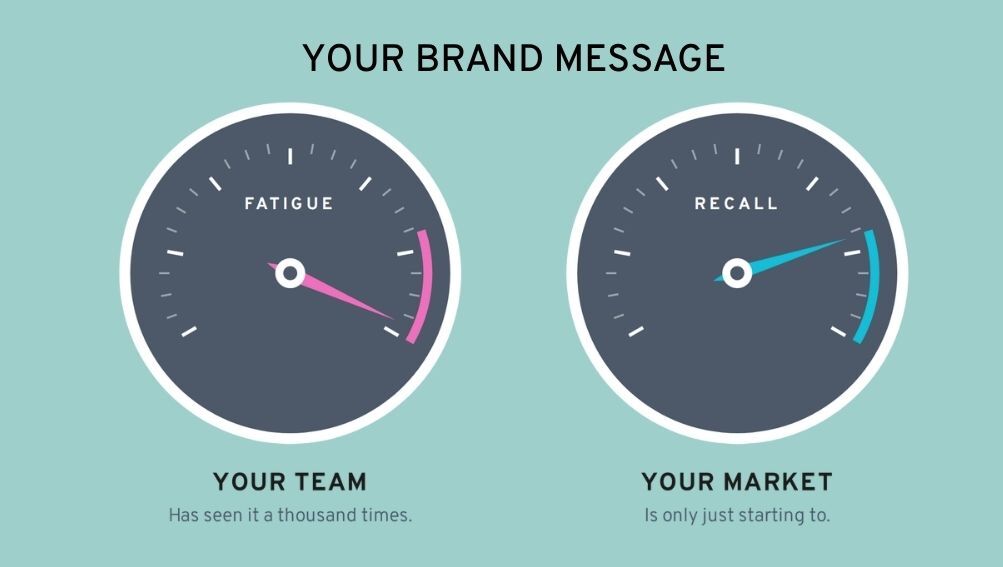
Being sick of your own brand message isn't the signal you think it is. More often than not, it means the message is working. By the time it feels worn out to the people who made it, most of your customers have barely registered it, so a refresh now tends to land right as recognition was finally starting to build.
Keep your brand message longer than it feels like you should. It's a compounding asset: recognition builds on repetition, and a refresh restarts that from zero, so the honest horizon is years, not campaign cycles. The one discipline that protects it is easy to say and hard to do: change on the market's signal, not the team's mood. In practice that means watching outside measures like unaided recall and share of search instead of the patience of the room. If those are holding while the team feels done, the message is still working. Being tired of it is usually a milestone, not a warning.
Start with the thing nobody puts in the plan: you and your customer aren't looking at the same message the same number of times.
By your brand message, we mean the core idea you run consistently across campaigns, the through-line rather than any single ad. The people who build and run it are soaked in it. They've seen every variant and read the same line a few hundred times before it ever goes out. Your customer meets it between other things, a handful of times if you're lucky, and forgets most of them. By the time it feels old to you, it's still new to almost everyone you're trying to reach.
That's the exposure gap, and it's the quiet engine behind most premature refreshes. Your internal odometer runs years ahead of the market's. So when a room decides the message is tired, it's usually reporting its own mileage, not the audience's.
The reason the gap matters is that recognition gets built by repetition, not by novelty. Byron Sharp's work at the Ehrenberg-Bass Institute is blunt about it in How Brands Grow: brands grow by consistently coming to mind for a large group of light buyers, people who think about your category rarely and about you almost never. They'll only remember you if the same cues keep showing up, the same way, again and again.
The effectiveness research backs this up with hard numbers. Across Les Binet and Peter Field's analysis of the IPA Databank, the single biggest driver of long-term growth is simple, even if it sounds backwards at first: brands that advertise like they're a little bigger than they already are tend to become bigger. The catch is that this builds slowly, over years rather than quarters, which is exactly why it's so easy to give up on too early. A consistent message is what turns each round of spend into memory that sticks. Swap it out for the sake of it, and you don't just change the creative; you wipe the memory the creative was building.
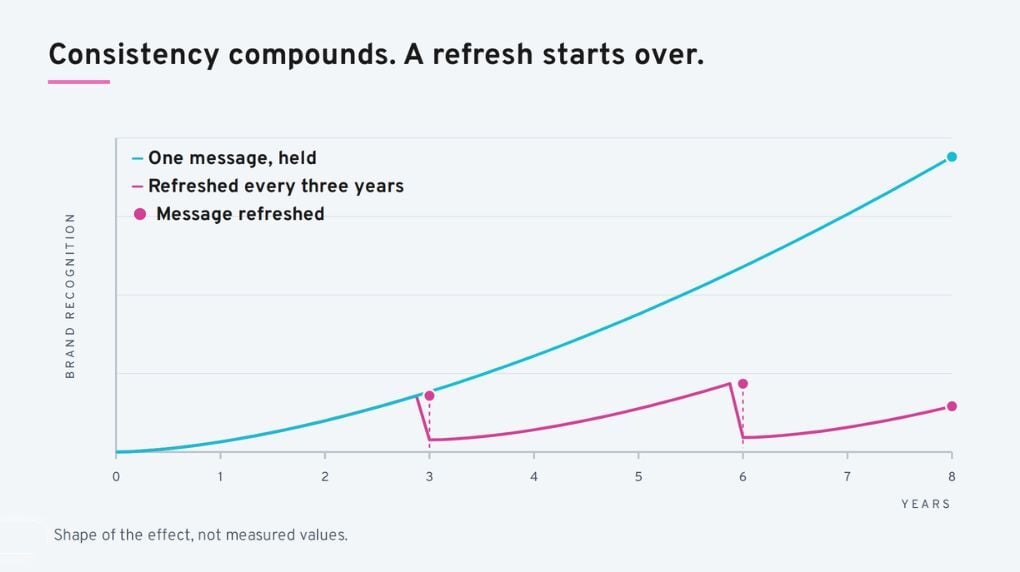
The brands that get this treat decades as the unit of time. Avis ran "We Try Harder" for 50 years before retiring it in 2012; the line outlasted most of the competitors it was written to beat. BMW's had "The Ultimate Driving Machine" since 1974, and the exception proves the rule: when it set the line aside for a "Joy" campaign around 2009, loyalists revolted and the company backed away within a few years. Both understood the difference between building a five-year brand and a twenty-year one. A five-year brand is always a little embarrassed by last year's work. A twenty-year brand treats consistency as the compounding asset it is, and learns to get bored on purpose.
This isn't just what we tell clients; it's how we run our own marketing.
"From our own marketing perspective, it's saying the same message over and over again in different ways — to make sure it sticks and lands and doesn't get too boring," says our media director, Aaron Ward — a discipline our creative team holds just as firmly. The boredom is the tax you pay for consistency, and it's meant to be felt on the inside long before it ever shows up on the outside.
Because it's visible, and durability isn't. A refresh comes with a kickoff, a new campaign, a deck to present, a sense that something's finally happening. Under pressure from a board or a new mandate, motion is reassuring in a way that patience never is. It looks like a decision.
The pressures that push a team toward a premature refresh are almost always internal, and it helps to say them out loud:
None of that is the market talking. It's the organization talking, and the organization is the one group guaranteed to be more sick of the message than anyone it's meant to reach. It's the same trap we describe in the hidden cost of scaling your marketing too soon: busywork mistaken for real momentum.
Watch the outside, not the inside. The two feel almost identical in a meeting and look nothing alike in the data. The trick is knowing which signals are telling the truth and which ones are lying to you.
Boredom, dressed up as insight. "We're bored of it," "it feels tired," "haven't we said this enough" are all statements about the team's exposure, not the market's.
Ad-level creative wear-out. This one's more convincing, because it comes with a chart. The click-through or engagement rate on a single execution slides as more people see it, more often. But that's a signal about that ad, not about your message. The fix is fresh creative for the same idea, not a new idea. Reading a tired ad as a tired message is how a brand throws out the whole positioning when all it needed was a new way to say it.
Wear-in, mistaken for failure. This is the sneakiest of the three. Brand effects take time to even become readable. Binet and Field find that much of a brand campaign's impact isn't visible in the first year, so a message that looks flat on short-term numbers may just not have finished landing yet. Kill it early and you don't fix a failure; you interrupt one that was about to turn into a win.
Genuine wear-out shows up outside the building, and it shows up as decline, not boredom: unaided recall flattening or falling, response fading across different executions of the same idea rather than within one, the message no longer moving the numbers it used to.
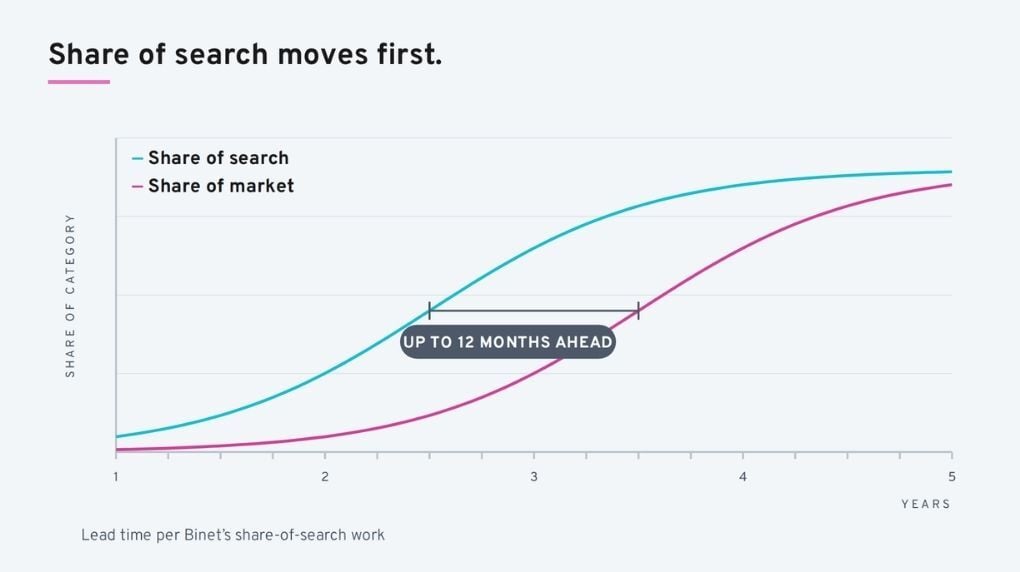
The most useful early warning is one you can watch for free. Les Binet's work on share of search, your slice of the category's search demand, shows it works as a leading indicator of market share, in some categories up to a year ahead. If your share of search is holding or climbing while the team feels done, the message is compounding, and that's the worst possible moment to reset it. If it's sliding, and it isn't just a media cut or a competitor's spike, you might have a real problem, and now you've caught it early instead of late.
Change the message when the market tells you to, not when the team does.
Sometimes a refresh genuinely is the right call, and pretending otherwise would be its own kind of theatre. There are two honest reasons to change a brand message. The first is a real strategic shift: a new market, a merger or acquisition, a genuine change in what you sell or who you sell to. When the underlying story changes, the message has to change with it. The second is evidence of true market wear-out, the outside decline we just walked through, not the inside boredom that does a good impression of it.
The urge to refresh comes from a good place. Nobody wants to be the brand that overstayed its welcome. But most messages get retired long before they're worn out, quietly killed by the people closest to them at the exact moment they were starting to land.
So the next time your own message makes you wince a little, treat that as information about you, not about the market. Check the outside signals. If they're holding, give the work the one thing it actually needs, which is time. Let it breathe and exist long enough to do the job it was built for. That wince you're feeling is usually the sound of something starting to work.
There's no fixed shelf life, but the honest answer is longer than it feels like you should. Message consistency is a compounding asset, so the right horizon is measured in years, not campaign cycles. The reason a change always feels overdue is exposure: your team sees the message hundreds of times before the market sees it a handful, so internal boredom shows up long before the message has finished doing its work.
Watch external evidence, not internal sentiment. The signals that genuinely warrant a change are things like unaided brand recall flattening or falling, share of search sliding for reasons that aren't a media cut, or a real shift in strategy, audience, or positioning. If the only thing that's changed is that the team is tired of it, that's not market fatigue, it's exposure, and it's the weakest reason to reset accumulated equity.
No, and confusing them is expensive. Creative fatigue is an ad-level effect: a specific execution's response drops as more people see it more often, and the fix is new creative for the same idea. Market fatigue is the underlying message itself wearing out across executions, which is far rarer and much slower. Internal boredom almost always shows up before either one, which is why the team's patience is the worst possible trigger for a change.
Yes. Effectiveness research from Binet and Field's work with the IPA shows brand effects build over years and consistency outlasts short-term activation. Frequent refreshes interrupt that compounding and reset the recognition you'd already banked, which is why long-running, consistent campaigns tend to outperform frequently-changed ones.
Because recognition is cumulative, and share of voice compounds it. Each consistent exposure builds on the last; a reset starts from zero. Consistency is one of the few marketing assets that compounds without extra spend, which is exactly why it's worth protecting. Put in budget terms: a premature refresh writes off the recognition you already paid to build and asks the next campaign to buy it back.
It can be, but "stale" is usually diagnosed from the inside. Before you act on it, look at whether the market shows wear-out — falling recall, sliding share of search — or whether only the team does. A brand can feel tired internally while it's still building recognition externally, and those two states call for opposite responses.
When the strategy actually changes — a new market, a merger, a real shift in what you sell or who you sell to — or when external data shows the message has genuinely worn out. Change on the market's signal, not the team's mood.
Create content that's worth your audience’s attention.