The attribution model your team relies on was probably the right choice when you adopted it. Last-click attribution made sense before multi-touch options were mature. Platform-level reporting made sense before cross-channel journeys became the norm. A north star metric agreed between two teams made sense before one of those teams reorganized.
None of these were bad decisions. They were reasonable calls, made with the information and options available at the time.
The problem is what those decisions become once the business moves on.
What used to feel manageable starts making everyday decisions harder than they should be. Reporting needs more explanation. Numbers stop lining up cleanly across systems. Budget conversations take longer to land because too much of the conversation is spent figuring out which data to trust. The issue isn’t a lack of information. It’s that the measurement layer underneath it no longer reflects how the business actually works.
That’s measurement debt.
Most companies aren’t dealing with a measurement gap. They’re dealing with measurement debt: the accumulated cost of reporting choices, marketing attribution compromises, and disconnected systems that once felt manageable and no longer work well together.
It usually builds quietly. No single decision creates it. It shows up later — in reporting that takes too much explaining, numbers that don’t quite hold together, and budget conversations that get harder to defend than they should be.
At lower spend, those issues can feel frustrating but tolerable. As investment grows, they become much harder to carry. What looked like a few manageable inconsistencies starts affecting confidence, decision-making, and the team’s ability to stand behind the story the data is telling.
Here we look at what measurement debt actually is, how to spot it, and why it becomes more expensive the longer it sits underneath the system.

Measurement debt rarely announces itself. It usually shows up as a pattern of smaller frustrations that are easy to treat as separate problems until they keep repeating.
Any one of these can be a rough patch. When several start showing up at once, it usually means the measurement layer is carrying more weight than it was built for. Here's the larger pattern this comes from.
It usually starts with a single source of truth that isn’t quite single.
Google Analytics tells one story. The ad platform tells another. The CRM, when someone checks it, tells a third. So a tool gets added to reconcile them. Then a spreadsheet to bridge what the tool missed. Then a marketing attribution model built during a stretch of high ambition that a few people understand and one person maintains.
Each addition solved a real problem at the time. None of them removed the complexity underneath.
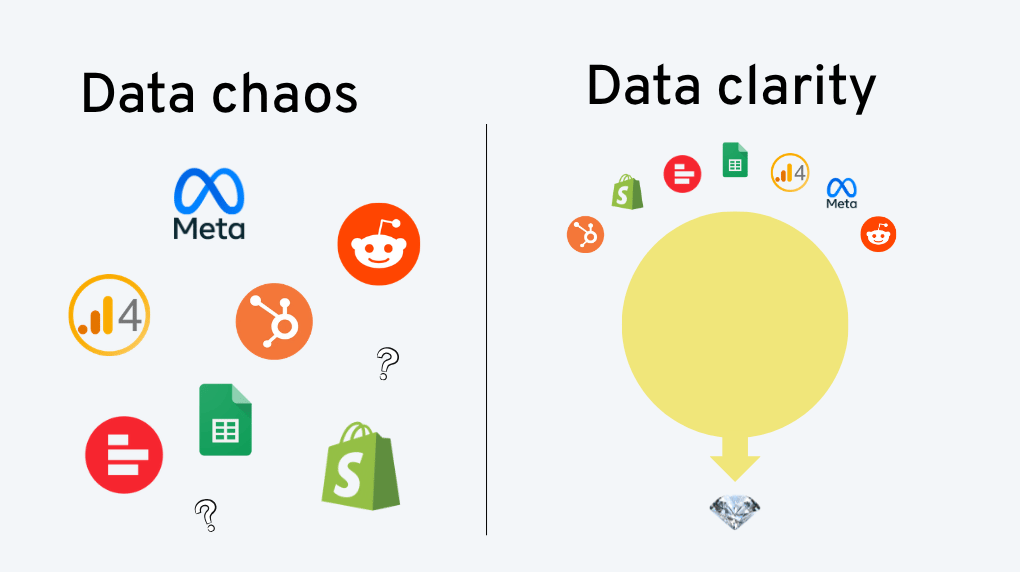
The most visible symptom is usually a marketing attribution gap: the growing distance between what each platform claims it delivered and what the business can actually verify.
As Caleb Maurice, Major Tom’s digital marketing analyst, puts it:
“Something that you often see is the segmentation and how data is siloed into different components of the business — that data isn’t working together to report on performance. There’s definitely a pendulum where the more complex, the less clarity.”
That is usually how the debt builds. A gap appears. Something gets added to patch it. The patch creates another layer to interpret. Over time, the system starts reflecting the history of every reporting problem the team has tried to solve, rather than a clear design for how performance should actually be understood.
And the longer that goes unrebuilt, the more the rest of the organization starts building on top of it — reporting rhythms, KPI definitions, budget conversations, and success criteria, all resting on a measurement layer that was never designed to carry that much weight.
Research from NIQ, summarized by Marketing Dive, shows how common this has become: 54% of CMOs say they struggle to connect data from different sources, up from 31% the year before, and one in three companies now needs between five and 15 tools just to measure ROI.
That is not a one-off reporting issue. It is a system carrying debt.
Measurement debt rarely feels critical at the spend level where it formed. The gaps are real, but still manageable. The attribution is imperfect, but consistent enough to work with. The dashboards disagree, but not enough to stop the work.
As Caleb Maurice describes it:
“There's something in product engineering called technical debt. When you make a compromise while building something because it takes less time or fewer resources, you end up paying for it over time. That debt accumulates and compounds. Measurement flaws scale the same way.”
The same issues that felt tolerable at $500,000 in annual media spend can become structural at $2 million. A 15% variance between your CRM and your ad platform is frustrating at lower volume. At higher volume, it becomes a credibility problem in every leadership conversation. Each additional dollar committed on top of a fragmented measurement layer carries more risk than the one before it.
AI does not fix this. It raises the stakes.
When optimization tools sit on top of measurement infrastructure that is already fragmented, they amplify the unreliable signals alongside the useful ones.
Aaron Ward, Major Tom’s media director, describes what this feels like when teams try to scale without that foundation:
“You're just investing dollars and hoping it's going to work — and you'll never be able to know if it worked because you don't have the measurement infrastructure properly in place to report on whether that dollar is actually working.”
The most visible cost tends to show up in the leadership conversation.
Only 22% of senior marketers say they have the measurement insight they need to justify value to their CFO, according to research summarized by The Drum. Think with Google’s research on the CMO-CFO relationship found that difficulty measuring long-term impact is the main source of alignment challenges between the two sides.
That gap does not stay in the finance meeting. It shapes how confidently marketing can defend budget, how seriously performance reporting is taken in planning conversations, and how much time senior teams spend explaining results instead of improving them.

As Aaron Ward puts it: “If it really comes down to something for clarity, it’s measurement. Because data really is the single source of truth that helps decision makers make the most informed decisions around the business.”
Caleb Maurice makes the same point from a different angle: “Ensuring there’s alignment on that north star metric is incredibly important for getting alignment from all different parts of the organization and defining what success looks like.”
When measurement debt erodes those shared definitions, teams can keep using the same language about performance while measuring completely different things. The disagreement that follows tends to look like a communication problem. More often, it is an infrastructure problem in disguise.
Uptempo’s State of the CMO Seat 2026 report describes the downstream version of this: credibility starts to erode when marketing spend cannot be reconciled with accounting, when performance data arrives after decisions need to be made, and when budget requests lack the quantitative grounding finance expects.
Gartner has framed the longer-term version of this as a doom loop: underfunded measurement leads to unclear impact, unclear impact fuels C-suite skepticism, and that skepticism makes it harder to secure the investment needed to fix the problem. Their research suggests that by 2027, more than 40% of CMOs who push for larger brand budgets without demonstrating returns will lose influence with the C-suite.
That is no longer just a reporting problem. It is a strategic one.
When measurement starts feeling unreliable, the instinct is usually to add something. A new attribution tool. Another dashboard. A more sophisticated reporting layer.
That instinct makes sense. It is also usually the wrong fix.
More platforms create more opportunities for variance between data sources. More metrics create more definitions in conflict. A more complex stack makes it harder, not easier, to answer a simple question about performance.
As Aaron Ward puts it: “Confidence comes from clarity, and clarity comes from factual data.”
Resolving measurement debt is not a volume decision. It is an architecture decision. It starts with shared definitions of what success actually means for the business, connected systems that let different teams look at the same picture, and reporting built around the decisions that need to be made, not just the activity that is easiest to track.
That work is less visible than a new tool purchase, and slower to show up than a dashboard refresh. It is also what actually retires the debt instead of adding to it.
The organizations that get this right do not end up with more data. They end up with more trusted data.
Measurement debt is the kind of problem that can sit in the background for a long time without forcing a real reckoning. Then it shows up all at once — in the budget conversation that suddenly needs much more defending, the planning cycle where no one agrees on what last quarter actually meant, or the post-mortem that produces disagreement instead of learning.
Those moments do not create the debt. They reveal it.
The decisions behind it were usually made months or years earlier. Each one made sense at the time. None of them looked serious enough on their own to justify rebuilding the system underneath. That is what makes measurement debt hard to solve through effort alone. At a certain point, it has to be addressed through architecture: a measurement layer built around how the business actually works now, not how it worked when the last tool was adopted.
That is the role of the measurement layer in the Growth Clarity Framework. Not more reporting, but the right kind: a connected, trusted view of performance that helps the business make decisions instead of just documenting activity.
Getting that right does not remove uncertainty from marketing. It does mean that when the hard questions come, the answers are easier to trust.
Wondering how much of a measurement dept your organization has right now? Let's talk it over.
Measurement debt is the accumulated cost of reporting choices, attribution compromises, and disconnected systems that once felt manageable but no longer work well together. It builds over time as teams add tools, metrics, and reporting layers to solve immediate problems without fully rebuilding the system underneath. The result is a measurement setup that can still produce data, but not always the clarity or confidence the business needs to make good decisions.
Marketing attribution is one part of measurement: it helps teams assign credit to the touchpoints that influenced a conversion. Measurement debt is broader. It includes attribution issues, but also the disconnected systems, conflicting definitions, and reporting structures that make performance harder to interpret and defend over time. In many organizations, attribution is where measurement debt becomes most visible first.
It usually builds through individually reasonable decisions. A platform gets adopted because it solves one problem. A dashboard gets added because the first view is not enough. A spreadsheet bridges what the tools missed. Over time, those additions create a stack that reflects the history of reporting fixes rather than a clear design for how performance should actually be measured. The debt does not come from one bad decision. It comes from layers that no longer work well together.
Common signs include dashboards that do not fully agree, reporting that takes too much explanation, attribution debates that last longer than the performance discussion itself, and budget conversations built more on directional evidence than trusted numbers. It can also show up when reporting arrives after decisions need to be made, or when adding a new channel creates another reporting view instead of improving the existing one. When several of those patterns appear together, the measurement layer is usually carrying more weight than it was built for.
Because measurement debt tends to compound. Each fix may solve an immediate issue, but if the underlying architecture stays fragmented, the system becomes harder to interpret over time. New tools add more data sources. New dashboards add more definitions. New reporting layers add more opportunities for mismatch. What feels like a series of isolated fixes can gradually turn into a more complex system that is harder to trust, defend, and scale.
A measurement gap is a missing piece of data. For example, a broken conversion event, an untracked touchpoint, or a channel that is not yet connected properly. Measurement debt is broader. It is the accumulated weight of systems, definitions, and reporting choices that are still in place, but no longer fit how the business and customer journey actually work. A gap is usually something you can fill. Debt is something you have to untangle.
Usually not. In many cases, it deepens it. More tools can create more variance between data sources, more conflicting definitions, and more complexity for teams to interpret. Measurement debt is not resolved by adding more reporting volume. It is resolved by improving the architecture underneath: shared definitions of success, connected systems, and reporting built around business decisions rather than channel activity alone.
Be both a dreamer and a doer.